Kipchumba Murkomen Faces Backlash Over Tribal Comments, Ahmednasir Abdullahi Weighs In


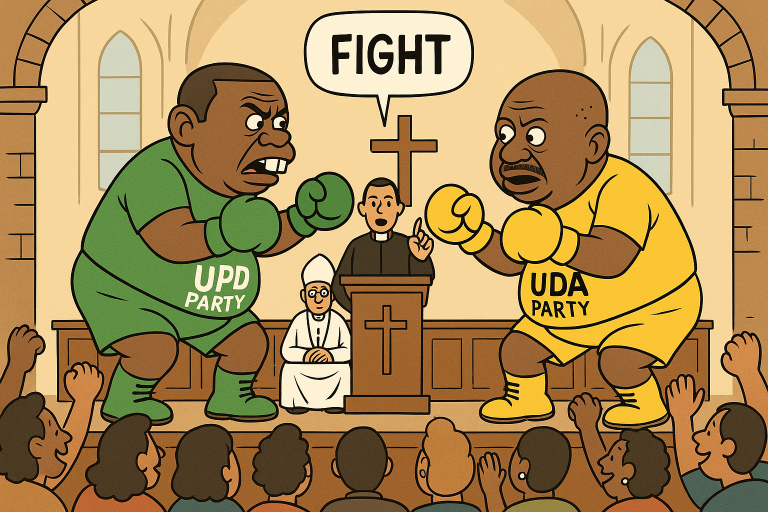
Nairobi, Kenya – Kipchumba Murkomen, the Cabinet Secretary for Youth Affairs, Creative Economy, and Sports, recently faced significant backlash after suggesting that criticisms of President William Ruto were rooted in tribalism. In a statement, despite being elected by Kenyans, Murkomen argued that the President was facing undue criticism because of his Kalenjin heritage. This sparked a heated debate across the nation, with many Kenyans expressing their discontent on various platforms.
Ahmednasir Abdullahi, a prominent Senior Counsel, responded sharply to Murkomen’s comments on X (formerly Twitter). Abdullahi dismissed Murkomen’s claims as “UTTER RUBBISH,” emphasizing that the critiques aimed at President Ruto were based on his performance and not his tribal background. Abdullahi stated, “Kenyans are criticing President William because they want him to succeed/deliver on his promises…his TRIBE is totally irrelevant and diversionary bwana Waziri @kipmurkomen. Deliver and Kenyans will dance on the street and name their newborn kids after H.E.”
However, in a surprising turn of events, Ahmednasir seemed to shift his stance in a subsequent series of posts, offering a more nuanced perspective on corruption perceptions under different administrations. He argued that while corruption under President Ruto’s government is perceived to be rampant, it is, in reality, significantly lower than during President Uhuru Kenyatta’s tenure.
“Corruption/stealing from the state/public during President William Ruto’s first 30 months in office is roughly at 20% of the theft/looting during Uhuru’s tenure. Fact. Yet public perception is that Ruto and his inner circle have looted Kenya clean,” Ahmednasir wrote.
Abdullahi attributed this disparity in perception to several factors, including political, ethnic, and sociological elements. He contended that corruption under Kalenjin leaders is viewed more harshly compared to Kikuyu leaders, whose corrupt practices are often seen as more sophisticated and socially acceptable.
“Kenyans generally see corruption during a Kalenjin president as wanton/malevolent. Kalenjin corruption is seen as raw/clumsy/ugly. Kikuyu corruption, on the other hand, right from Jomo Kenyatta, is seen as ‘dignified’, the normal act of smart politicians and businessmen,” he explained.
He further elaborated that Kalenjin corruption tends to be conspicuous and consumption-oriented, making it more visible and offensive to the public. In contrast, Kikuyu corruption is often masked as business investments, thus gaining a level of acceptance.
“Kikuyu presidents tightly regulate corruption from a class point of view. Poor Kikuyus are never allowed to steal from the state. Kenyatta never allowed. Kibaki and Uhuru never allowed it either. Kalenjin presidents, on the other hand, see corruption from an egalitarian viewpoint, an equaliser of sorts,” Ahmednasir added.
Abdullahi’s detailed analysis sparked extensive discussions online, shedding light on the complex dynamics of corruption in Kenya and how it is perceived differently based on ethnic lines. His observations highlight the deep-rooted issues that continue to influence public opinion and the political landscape in Kenya.
As the debate continues, Kenyans are calling for accountability and transparency from their leaders, regardless of their tribal affiliations, to ensure that the nation’s resources are used for the benefit of all citizens.