
What Does It Really Mean to Have Veto Power? Understanding Africa’s Fight for a Seat at the UN Security Council

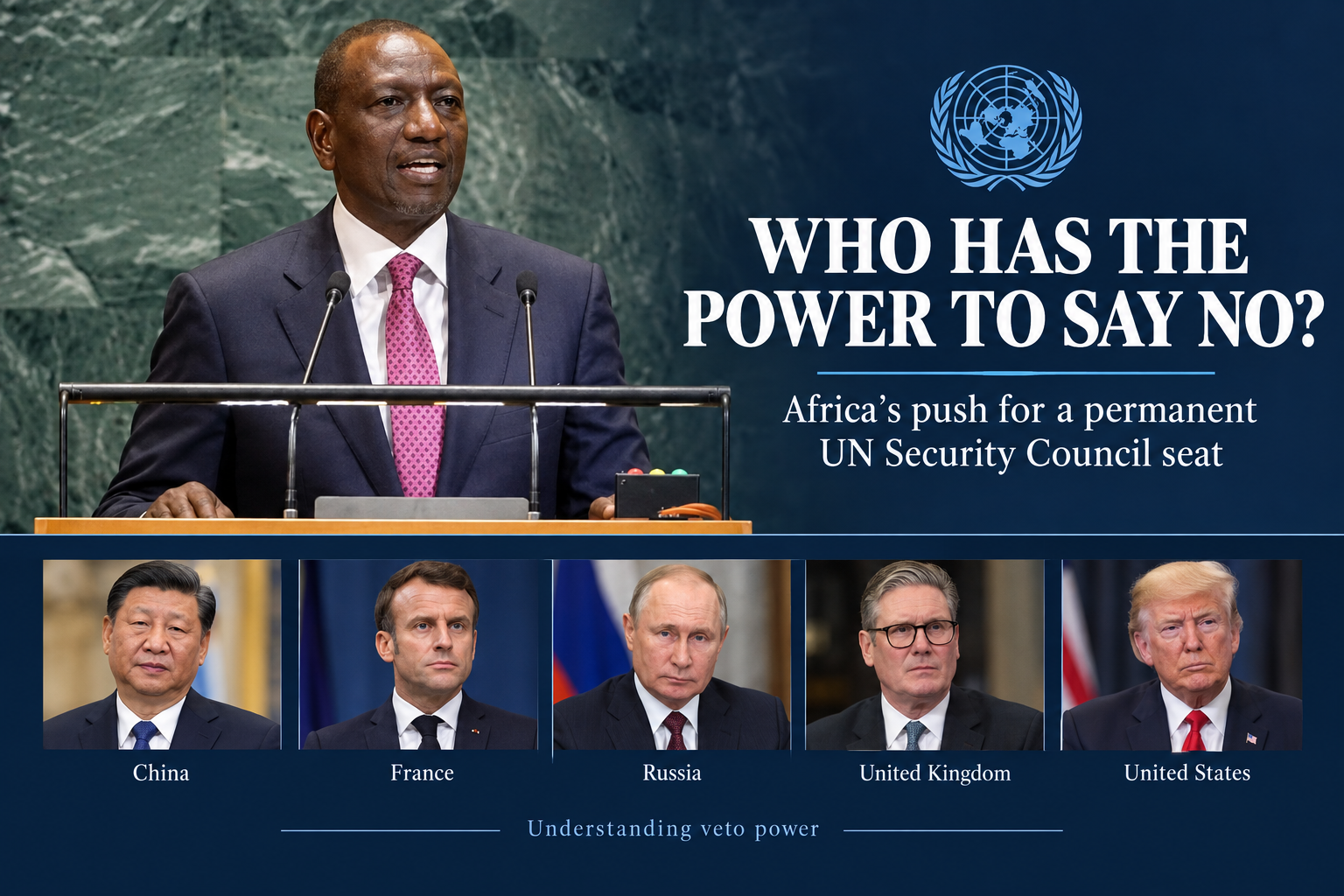
When people hear that Africa wants a permanent seat on the United Nations Security Council, one question is often left unanswered:
What exactly would that seat give Africa?
To understand why the issue matters so much, you first need to understand how the Security Council works, who sits on it, how decisions are made and, most importantly, what the word veto really means.
The UN Security Council is the part of the United Nations with primary responsibility for maintaining international peace and security. It can, in certain circumstances, impose sanctions, demand that countries take particular actions and authorise the use of force. UN member states are obligated under the UN Charter to comply with Security Council decisions.
And this is where the difference between an ordinary member and a permanent member becomes extremely important.
The Security Council has 15 members
The Security Council is made up of 15 countries.
Five are permanent members:
- China
- France
- Russia
- United Kingdom
- United States
These five are commonly called the P5.
The other 10 countries are non permanent members, sometimes called the E10. They are elected by the UN General Assembly for two year terms. A country completing its term cannot immediately be re elected.
As of September 2026, the 10 non permanent members are:
Bahrain, Colombia, Democratic Republic of the Congo, Denmark, Greece, Latvia, Liberia, Pakistan, Panama and Somalia.
Notice something important here.
Somalia is currently representing Africa on the Security Council, while the Democratic Republic of the Congo and Liberia are also serving as African members.
But none of them is a permanent member.
That distinction is at the heart of Africa’s campaign for reform.
Do non permanent members have a vote?
Yes.
This is one of the most important things to understand.
Every one of the 15 members has one vote.
So the United States has one vote.
China has one vote.
France has one vote.
Somalia has one vote.
Kenya would also have one vote if it were elected to the Council.
On paper, therefore, all 15 countries have equal voting rights.
But in practice, the five permanent members have something the other 10 do not have:
THE VETO.
And that changes the balance of power dramatically.
How does a Security Council decision actually happen?
Suppose the Security Council is considering a resolution.
The 15 countries debate the issue and eventually vote.
For a procedural matter, at least nine members must vote in favour.
For most other substantive matters, at least nine members must vote in favour, including the required agreement of the permanent members.
This creates a very important distinction.
Imagine the vote is:
14 countries: YES
1 permanent member: NO
The resolution can fail.
Why?
Because the permanent member has used its veto.
Now imagine:
10 countries: YES
5 permanent members: ABSTAIN
The resolution can still pass because an abstention by a permanent member is not the same as a veto, assuming the required nine affirmative votes have been reached.
That is why the veto is so powerful.
So what exactly is a veto?
A veto is essentially the power of a permanent member to say:
“I do not agree, and this resolution will not pass.”
One permanent member voting against a substantive resolution can prevent it from being adopted, even when the other 14 members support it.
That is the special power the five permanent members possess.
It is also why having a permanent seat is fundamentally different from having an elected seat.
A non permanent member can participate in debates, propose and support resolutions, negotiate with other countries and vote.
But it cannot unilaterally block a substantive resolution.
A permanent member can.
Why doesn’t the Security Council simply use majority rule?
Because the system was designed differently when the United Nations was created.
The five permanent members were given their special status because of their roles as the major Allied powers that established the post Second World War international system.
The compromise was that these major powers would participate in collective decisions on international peace and security, but they would also retain the ability to prevent the Council from taking certain substantive decisions against their fundamental interests.
Whether that system remains appropriate in today’s world is one of the central questions behind Security Council reform.
Where does Africa fit into this?
This is where the debate becomes much more interesting.
Africa has 54 countries in the United Nations, but no permanent seat on the Security Council.
African countries can and do serve as non permanent members.
For example, Somalia is currently serving on the Council.
But Somalia has the same voting power as every other member when it comes to counting votes and does not possess a veto.
The African Union therefore wants the structure of the Council changed.
Under the Ezulwini Consensus and Sirte Declaration, Africa is seeking at least two permanent seats and five additional non permanent seats. The African position also says that if the veto continues to exist, African permanent members should have the same rights as the existing permanent members.
This is an important distinction.
Africa’s argument is not simply:
“Give us a seat.”
It is closer to:
“Give Africa permanent representation and do not create permanent members with fewer rights than the existing permanent members.”
Why does Africa want the veto if it has criticised the veto?
This is one of the most misunderstood parts of the debate.
The African position has generally criticised the existence of the veto.
But Africa also argues that it cannot accept a system where the existing permanent members retain veto power while newly created African permanent members are permanently excluded from it.
In other words:
If the veto remains, African permanent members should have equal rights.
If the international community eventually agrees to abolish the veto altogether, that would be a different system.
The issue is therefore fundamentally about equality within whatever system eventually exists.
President Ruto and Kenya’s position
Kenya has been particularly vocal about Security Council reform.
President William Ruto has repeatedly called for greater African representation in the Security Council and has argued that Africa should have a permanent voice in the institution responsible for many of the world’s most important decisions on international peace and security.
Kenya’s formal position goes further than simply requesting representation.
Kenya has supported the African position that, if the veto is retained, new African permanent members should receive the same rights as existing permanent members.
This explains why the question of veto power is so important to Kenya and other African countries.
A permanent African seat without the ability to participate equally in the most powerful part of the Council’s decision making would create a different category of permanent membership.
But why are many African leaders not speaking loudly about it?
This is where the politics become complicated.
African countries broadly share the continental position through the African Union, but individual countries have different foreign policy interests, relationships with the major powers and ambitions within Africa.
There is also a very difficult question hiding underneath the demand for “two African seats”:
Which African countries would actually occupy them?
Would the seats belong to particular countries permanently?
Would the African Union select the representatives?
Would the seats rotate among African regions?
Should countries such as Kenya, Nigeria, South Africa, Egypt or other candidates be considered?
And would every African country accept the final arrangement?
These questions can make governments cautious about turning the issue into a public competition among African states.
There is therefore a difference between supporting the principle of African representation and openly campaigning for a particular country to occupy the seat.
The African Union’s common position provides the continental framework, but the details of representation remain part of the wider reform debate.
The current African members show why this matters
The presence of African countries on the Council demonstrates that Africa already has a voice.
But it is a temporary voice.
For example, Somalia’s current term ends in December 2026. The same applies to other non permanent members when their two year terms expire.
A permanent seat would mean that Africa would have representation at the Council continuously rather than having to compete for elected seats every few years.
But the bigger issue is not simply being in the room.
It is what power you have once you are in the room.
What happens when the 15 countries disagree?
Imagine the Security Council is considering a resolution concerning a major international conflict.
The 15 members discuss it.
After negotiations, the proposed resolution comes to a vote.
If nine or more countries vote in favour and none of the permanent members casts a veto, the resolution can pass.
But if one permanent member votes against it, the resolution fails.
The other 14 countries cannot simply override that veto.
That is the extraordinary power Africa is debating.
The 10 non permanent members still matter
It would be wrong to conclude that the non permanent members are powerless.
They can influence negotiations, draft resolutions, participate in committees, chair meetings, build coalitions and vote on every matter before the Council.
The presidency of the Security Council also rotates among all 15 members, with each member holding it for one calendar month.
So a non permanent member can have significant diplomatic influence.
The difference is that its influence is temporary and does not include the veto.
The bigger question: Should the Security Council still look like 1945?
That is ultimately what the reform debate is about.
The world has changed dramatically since the United Nations was created.
Africa’s population, economies and geopolitical importance have grown considerably. Yet the basic structure of the Security Council still gives permanent status to the same five countries.
The argument from African governments is that a continent with 54 UN member states should have permanent representation in the institution responsible for international peace and security.
The counterarguments focus on questions such as how many new permanent members should be created, whether new members should receive veto power and whether adding more veto holders would make the Council more effective or more difficult to act through.
There is no simple agreement on these questions.
So what would an African permanent seat actually change?
It depends on the final reform.
An African country receiving a permanent seat without veto power would have continuous representation and a permanent place in Council deliberations, but it would not be able to block a substantive resolution by itself.
An African country receiving a permanent seat with veto power would have that additional ability to prevent a substantive resolution from being adopted.
And if the veto were eventually abolished altogether, the entire voting structure would change.
That is why Africa’s demand is not merely about a chair in a conference room.
It is about who gets to make decisions, who gets to stop decisions, and whose interests are permanently represented when the world’s most serious security questions are being decided.
For Kenya, President William Ruto’s advocacy puts the country among the African voices pushing this question into the international spotlight.
But the outcome will depend on negotiations involving all UN member states, the African Union and, critically, the existing five permanent members.
The debate is therefore bigger than Kenya, bigger than Somalia and bigger than any single African country.
It is a debate about whether the institution created to reflect the balance of power after the Second World War should be redesigned to reflect the world as it exists today.
And at the centre of that debate is one deceptively simple question:
If Africa finally gets a permanent seat at the table, will it also have the power to say no?


