FACTS OR NONSENSE?!

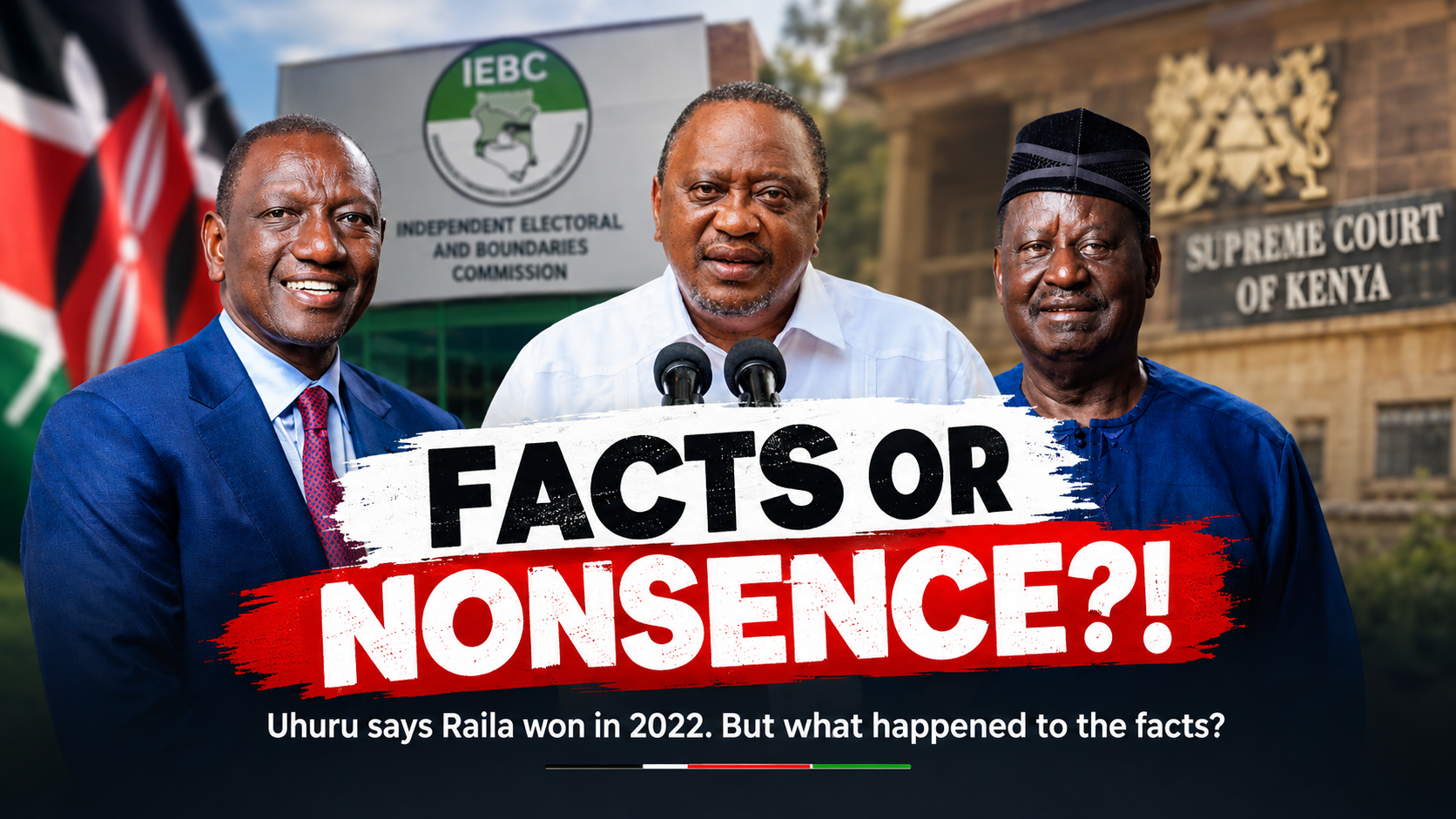
Uhuru Kenyatta says Raila won in 2022. But what happened to the facts?
Four years after the 2022 presidential election, former President Uhuru Kenyatta has reopened one of Kenya’s most politically sensitive chapters.
Speaking during a Jubilee Party National Executive Council meeting in Nairobi on September 22, 2026, Kenyatta said he still believes that Raila Odinga won the 2022 presidential election.
“I know that he won that election,” Kenyatta said, according to reports of his remarks. He also questioned how the political alliance supporting Odinga could have won more members of Parliament, senators and governors while losing the presidency.
That is a serious political claim.
But it immediately raises an equally serious question:
If Uhuru Kenyatta knew in 2022 that Raila Odinga had actually won, why did he not say so then?
At the time, Kenyatta was not an ordinary political observer. He was the sitting President of the Republic of Kenya and Commander in Chief of the Defence Forces.
He had spent five years working with William Ruto as his Deputy President before their political relationship collapsed. In the 2022 election, Kenyatta openly supported Raila Odinga against his former deputy.
So the question is not whether Uhuru was entitled to have an opinion about who won.
He was.
The question is whether an assertion made four years later should simply replace the official record without new evidence.
What does the official record say?
On August 9, 2022, Kenyans went to the polls.
The Independent Electoral and Boundaries Commission declared William Ruto the winner with 7,176,141 votes, representing 50.49 percent.
Raila Odinga received 6,942,930 votes, representing 48.85 percent.
The result was challenged in the Supreme Court.
That is important because Kenya did not simply move from an election declaration straight to a swearing in ceremony without judicial scrutiny.
The presidential election was taken to the country’s highest court.
On September 5, 2022, the Supreme Court unanimously dismissed the presidential election petitions challenging Ruto’s victory. The court’s judgment is part of the official judicial record.
William Ruto was subsequently sworn in as Kenya’s fifth president on September 13, 2022.
These are not political opinions.
They are documented events.
So what exactly are we being told today?
The new argument appears to be that Raila actually won the election despite the official declaration and the subsequent Supreme Court decision.
That is a very different claim from saying that the election was politically controversial.
There is nothing unusual about questioning an election. Citizens, politicians, journalists and institutions have every right to scrutinise an electoral process.
But if someone now says that the wrong person was declared president, the obvious next question is:
Where is the evidence?
Where are the figures?
Where is the evidence showing that the presidential tally was wrong?
Where is the evidence that the declared result should have been reversed?
Where is the evidence that was not presented successfully before the Supreme Court?
And perhaps most importantly, why was this information not presented to Kenyans when it mattered most?
The timing matters
Uhuru Kenyatta’s latest remarks come more than four years after the election and at a time when Kenya is already entering another politically charged period.
That does not, by itself, prove that his remarks are politically motivated.
His motives should not be assumed without evidence.
But the timing inevitably invites scrutiny.
If the former president possessed information demonstrating that Raila Odinga had won the election, the most consequential moment to disclose that information would have been in 2022, when the dispute was before the country and the courts.
Four years later, Kenyans are entitled to ask why the alleged truth was not placed before them at the time.
Uhuru was part of the story
There is another uncomfortable dimension to this debate.
Uhuru Kenyatta was not watching the 2022 election from the sidelines.
He was the sitting president.
He had endorsed Raila Odinga.
His Jubilee Party was part of the political alliance supporting Odinga.
He had spent years in government alongside William Ruto.
And when the Supreme Court upheld the election outcome, the country proceeded with a constitutional transfer of power.
The fact that Uhuru Kenyatta did not personally control the IEBC should also be acknowledged. Kenya’s electoral commission is constitutionally independent. But the former president certainly occupied a position of enormous political and institutional authority during the election and its aftermath.
That makes his present claim particularly significant.
What about the Supreme Court?
This is where the argument becomes difficult to sustain without new evidence.
The Supreme Court did not simply announce that Ruto had won and end the matter.
The election was challenged.
The petitions were heard.
The Supreme Court ultimately dismissed them.
The court’s decision became the final judicial determination on the presidential election petitions.
That does not mean every Kenyan must personally believe that the election was perfect.
It does mean that anyone making a fundamentally different claim years later carries a very serious burden of evidence.
Saying “I know Raila won” is not the same thing as demonstrating how the official result was wrong.
Kenyans deserve evidence, not political revisionism
There is a legitimate conversation to be had about the 2022 election.
There were political tensions.
There were disagreements about the electoral process.
There were competing narratives about what happened at the Bomas of Kenya.
There were also legal challenges.
Those matters can and should be discussed using evidence.
But Kenya cannot continually rewrite its political history every time an election approaches.
If there is credible new evidence that fundamentally changes what happened in 2022, then that evidence should be presented openly.
Let Kenyans examine it.
Let journalists investigate it.
Let constitutional experts analyse it.
Let the relevant institutions respond.
But simply telling Kenyans four years later that the person declared the loser actually won does not, by itself, establish that he won.
FACTS OR NONSENSE?!
The facts available in the public record are straightforward.
The IEBC declared William Ruto the winner.
Raila Odinga challenged the result.
The Supreme Court considered the petitions and dismissed them.
Ruto was sworn in as president.
Those are historical facts.
Uhuru Kenyatta is now saying that, in his view, Raila Odinga won.
That is his political assertion.
The two should not be confused.
If there is new evidence, let it be produced.
If there is none, Kenyans are entitled to question why a settled electoral dispute is being reopened four years later.
Kenya has experienced enough political tension around elections.
Some people paid very high personal prices during those periods. Families were divided. Communities were frightened. The country needed a peaceful transition.
That is precisely why claims about who actually won an election should be treated with the seriousness they deserve.
If you know the truth, show the evidence.
Because history should be written by facts, not by whoever finds a new political use for an old election.